Materials
Kitchen worktops: laminate, quartz or granite, and when the upgrade pays off
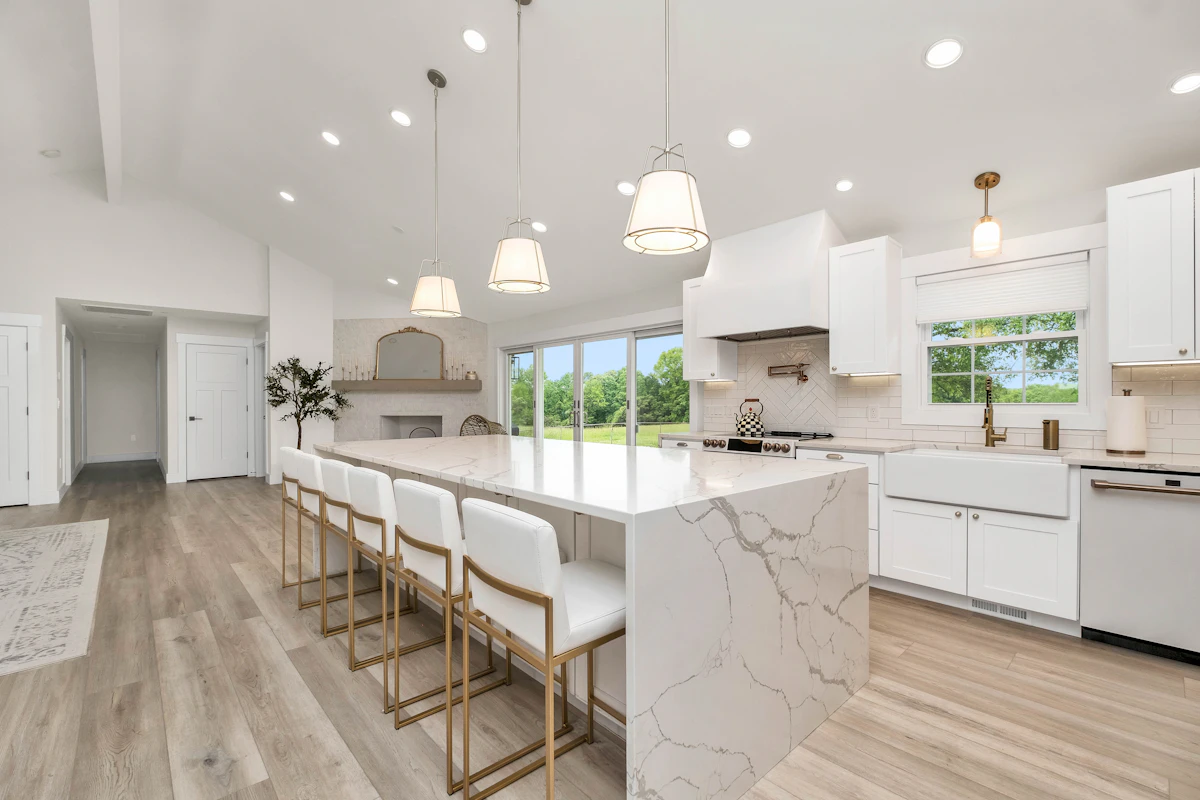
A fitted kitchen worktop in Portugal costs between 150 and 400 €/m², averaging 275 €/m². Those figures come from the habitissimo.pt price guide, updated on 10 June 2026 and built from more than 7,100 real quote requests. It is not a catalogue estimate.
Laminate sits below that scale, because it is sold as a board rather than by the square metre. At IKEA, in July 2026, a 2.46 m JÄRSTORP board cost €39.99, and the EKBACKEN and SÄLJAN ranges ran €65 to €75 for the same length. That works out at 16 to 40 € per linear metre.
This is why the same kitchen, with the same units, can carry a €150 worktop or a €2,400 one.
What each material costs
| Material | Fitted price | Handles well | Fails at |
|---|---|---|---|
| Post-formed laminate | 16 to 40 €/linear m | Normal use, light scratches | Water at the joints and around the sink |
| Solid wood | 40 to 200 €/m² | Repair (sand it back and it looks new) | Constant damp; needs oiling periodically |
| Granite | 90 to 300 €/m² | Heat, knives, heavy use | It is porous: stains if not sealed |
| Engineered quartz | 160 to 800 €/m² | Stains, acids, daily use with no upkeep | Direct heat: the resin marks and does not recover |
| Stainless steel | around 300 €/m² | Heat, hygiene, water | Scratches visibly and dents |
The stone, wood and steel figures come from the same source and the same date. The quartz range is wide because it covers everything from plain engineered slabs to designer series.
A note on brands, because it is the next question: Silestone, Compac and Technistone are engineered quartz. Dekton and porcelain surfaces are a different family, sintered under high pressure, and they handle heat considerably better. Ten-year-old Silestone prices still circulate online; they are no use as a reference and we have left them out.
Porcelain, Dekton and wood: the options left out of the comparison
The usual argument is laminate against quartz against granite. Two more deserve a mention, because they solve specific problems.
Porcelain and Dekton. These are slabs sintered under high pressure, with no resin. That changes one thing that matters: they take a pan straight off the hob without marking, which neither quartz nor laminate will do. They cost more than most quartz and have a weakness of their own — they are thin, and a sharp knock can chip the edge. In a kitchen where someone genuinely cooks every day, this is the surface that ages best.
Solid wood. At 40 to 200 €/m², it is the only worktop that improves with repair: a burn or a deep scratch sands out and disappears, which is impossible in quartz. In exchange it wants oiling periodically and dislikes permanent damp. Next to the sink is always the risk zone. It works well on an island or a secondary run, and badly as the only surface in a hard-working kitchen.
One word on thickness, since it appears in every quote: slabs are mostly sold in 12, 20 and 30 mm. The thickness you see can be built up with a bonded edge, so a 12 mm slab with a thickened edge looks like 30 mm and costs considerably less. That is not a trick, as long as it is written into the quote.
Where the money goes in a worktop
The advertised price per m² is rarely what you pay. The final bill breaks down like this.
The slab. This is the part that varies with the material and the part everyone compares. On a quartz worktop it runs to about two thirds of the total.
The labour. Around 50 €/m², covering measurement, transport and fitting. On a small kitchen it weighs proportionally more, because the visit and the measuring cost the same over 3 metres as over 8.
The cut-outs. Sink, hob, worktop sockets. Each opening is workshop time and is usually charged separately. An undermount sink is more work than one that drops in from above, and the price reflects that.
The edge. A square edge is standard. Rounded, bevelled or built-up profiles push the figure up, because they need more material and more finishing.
The joints. An L-shaped or U-shaped worktop rarely comes out of a single piece. Every joint is a piece of work and, later on, the point where water tries to get in.
Worth remembering When comparing two worktop quotes, confirm that both include cut-outs, edge profile and fitting. It is common for one of them to cover the slab alone. The difference between the two can be 30 to 40% and appear nowhere on the page.
A typical example, line by line
This is not an invoice of ours: it is what the figures above add up to for an L-shaped kitchen of 4.2 linear metres in a two-bedroom flat, with a drop-in sink and an induction hob. In mid-range quartz:
| Item | Amount |
|---|---|
| Quartz slab, ~3.4 m² usable | €810 |
| Cut and opening for the sink | €115 |
| Cut and opening for the hob | €90 |
| Square edge, 4.2 m | included |
| Measurement, transport and fitting | €195 |
| Total | €1,210 |
The same kitchen in shop-bought post-formed laminate, fitted, comes to €180 to €260. The difference of roughly a thousand euros is the real value of the decision, and it is those thousand euros worth thinking about, not the price per square metre.
For reference, habitissimo publishes real quotes that line up with this order of magnitude: compact quartz over 10 metres at €2,400, granite over 5 metres at €600, marble over 5 metres at €850.
When the upgrade pays, and when it does not
There is no single answer here, and the answer changes with what you plan to do with the kitchen.
It pays when the kitchen is yours and it is staying. The advantage of quartz is not how it looks, it is how it behaves over ten years: no visible joints around the sink, no periodic sealing, no swelling if a glass drips overnight.
It pays when the kitchen opens onto the living room. At that point the worktop stops being a work surface and becomes furniture on display. It is the one case where paying for appearance sits easily with us.
It does not pay in a flat you are letting. A tenant does not price the worktop into the rent, and post-formed laminate handles a letting cycle perfectly well. Landlords often fit quartz and recover none of it in the rent.
It does not pay if you are selling soon. Buyers discount what they dislike and rarely pay extra for what they like. A clean, functional kitchen with no defects sells; an expensive worktop does not change the offer.
It does not pay if it forces a cut somewhere else. If the quartz worktop eats the budget for the electrics or the plumbing, the sums are wrong. What sits hidden inside the wall is what causes expensive problems; a worktop, if it ever fails, is replaced without breaking anything.
What to ask before you sign
Whether cutting is done wet or with extraction. This is not about product quality, it is about the safety of the people fabricating it. Engineered quartz is among the materials with the highest crystalline silica content, well above natural stone, and respirable silica dust is classified as a carcinogen. In Portugal, Decreto-Lei n.º 102-A/2020 of 9 December set the exposure limit at 0.05 mg/m³ from 1 January 2023. Wet cutting and extraction are the usual way of meeting that limit, and a workshop that has them tends to have the rest in order too. For you at home this changes nothing: a worktop already cut and installed releases no respirable dust. The risk sits at the moment of cutting, in the workshop, and it belongs to the people working there.
Where the joints will fall. Ask to see it on the drawing, before the slab goes to be cut. A well-placed joint sits somewhere dry and goes unnoticed for years; a badly placed one sits beside the sink, and then it is only a matter of time before it starts darkening under the silicone. On an L-shaped worktop there are almost always two possible positions, but only before the cut.
Whether the cut-outs are included. It is the most frequent extra.
What the real thickness is. A 12 mm slab with a built-up edge looks like 30 mm but is not. There is nothing wrong with that, as long as you know what you bought.
How long it takes between measurement and fitting. The worktop is only measured once the units are installed and levelled, and then it goes into production. One to two weeks is normal. During that period the kitchen has cabinets but no work surface and no connected sink, and it is worth knowing that before booking your return home.
How this fits the kitchen budget
On our own figures, units and worktop together are about 40% of a kitchen budget. The worktop on its own is the easiest slice to adjust without touching anything else: it does not depend on the building work, it does not depend on the appliances, and it is decided late.
Across our three levels the worktop follows the rest of the project: post-formed laminate at budget level, mid-range laminate or compact at mid level, quartz or granite with a continuous finish at premium. It is not a rigid rule. We have built budget-level kitchens with a stone worktop, when that was what made sense for the people who were going to live there.
If you want the total before choosing the material, the prices by level for a complete kitchen show how much this choice weighs in the whole. And if the worktop is part of a larger job, the per-m² prices for the whole flat help frame it.
The fixed figure, with the worktop itemised separately and the cut-outs included, is confirmed after the site visit, before the work starts.
Frequently asked questions
Fitted, the average is around 275 €/m², with most cases between 150 and 400 €/m² (habitissimo.pt price guide, updated 10 June 2026, built from more than 7,100 real quote requests). By material, the same source gives 90 to 300 €/m² for natural stone, 160 to 800 €/m² for engineered quartz, 40 to 200 €/m² for wood and around 300 €/m² for stainless steel. Laminate sits outside that scale: bought as a board it runs 16 to 40 € per linear metre.
It depends how long you will live with it. In a flat you are letting out, or selling within a year or two, post-formed laminate does the job and the price difference stays in your pocket. If it is your own home and you expect ten years or more out of it, quartz earns its place for a reason that has nothing to do with looks: no visible joints around the sink, and that is where worktops die.
Granite is natural stone, cut from a block. Quartz is engineered: quartz dust bound with resin. In practice granite handles heat better because there is no resin in it, but it is porous and needs resealing from time to time. Quartz needs no sealing and has an even colour, but a pan straight off the hob can leave a permanent mark. Neither is better at everything.
No, and this is where people lose time. The real measurement is taken with the units already installed and levelled, and only then does the worktop go into production. One to two weeks between measurement and fitting is normal. During that period the kitchen has cabinets but no work surface and no connected sink.
You should not. The resin binding the quartz dust does not tolerate thermal shock, and the mark it leaves is usually permanent. On granite and on porcelain surfaces the risk is much lower. Whatever the material, a trivet costs a few euros and avoids a problem with no simple repair.
Three things: whether cutting is done wet or with extraction, whether the quote already includes the cut-outs for sink and hob, and where the joints will fall. The first is a safety question for the people cutting the stone, because engineered quartz is among the materials with the highest crystalline silica content. The other two are the ones that tend to reappear later as extras.
Want a real number for your own case?
The figures above are market references. Your fixed quote, in writing, is confirmed after we see the space.